
What Is Deuteranopia? Causes, Colors, Signs & Testing
Deuteranopia is a type of red-green color vision deficiency in which normal medium-wavelength-sensitive cone function is absent. These cone cells are often described as the eye's "green-sensitive" cones because they respond strongly to wavelengths in the middle part of the visible spectrum.
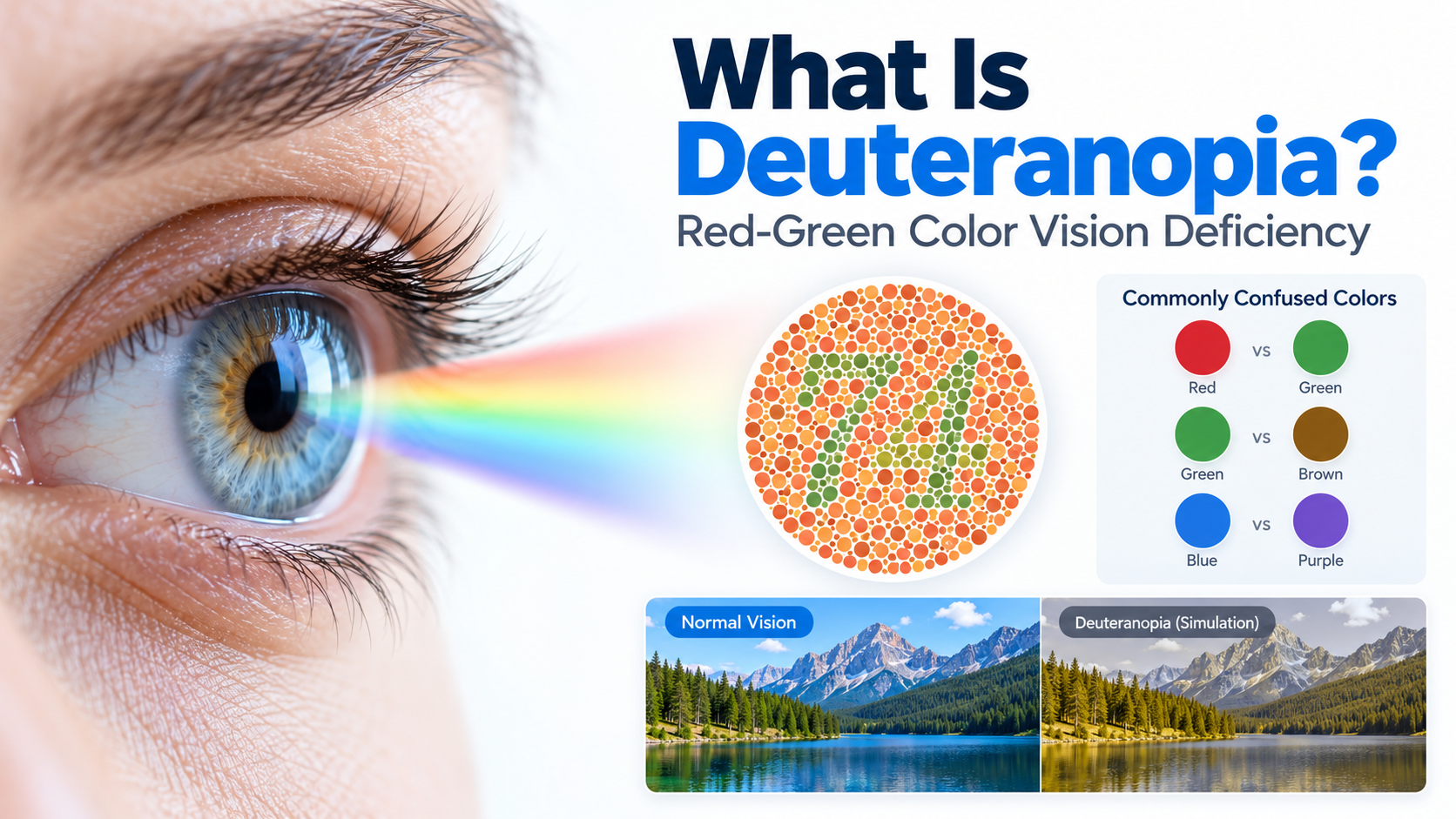
People with deuteranopia still see color. However, certain reds, greens, browns, oranges, purples and other shades can appear much more similar than they do to someone with typical color vision.
Deuteranopia belongs to a broader group called deutan color vision deficiencies. A milder and more common form is called deuteranomaly.
If you are new to the subject, start with our guide to what color blindness is and how color vision works. If you are wondering about your own color vision, you can also try the free ColorBlindChecker color vision test.
What Does Deuteranopia Mean?
The word deuteranopia describes one of the main forms of inherited red-green color vision deficiency.
Human color vision normally depends on three cone systems in the retina:
- L cones — most sensitive to longer wavelengths
- M cones — most sensitive to medium wavelengths
- S cones — most sensitive to shorter wavelengths
The brain compares signals from these cone systems to distinguish colors.
In deuteranopia, normal M-cone function is absent. Because the brain receives less information for separating colors that depend heavily on comparisons between L-cone and M-cone signals, many shades along the red-green portion of color space become harder to distinguish.
Deuteranopia vs. Deuteranomaly
Deuteranopia and deuteranomaly are related, but they are not the same.
Deuteranopia is the stronger deutan form. Normal M-cone function is absent, producing a more pronounced red-green color discrimination difference.
Deuteranomaly occurs when the M-cone photopigment functions differently rather than being completely nonfunctional. It is generally milder and is one of the most common forms of inherited color vision deficiency.
Both conditions are often casually described as "green color blindness," but that phrase can be misleading. A person with deutan color vision deficiency does not simply stop seeing green. Instead, the relationships between multiple colors change, causing certain shades to become difficult to tell apart.
What Colors Are Difficult to Distinguish With Deuteranopia?
There is no single list of colors that every person with deuteranopia will confuse in every situation. Brightness, saturation, surrounding colors and lighting conditions all affect how easy a color is to identify.
In general, deuteranopia creates the greatest difficulty when colors depend heavily on differences between red and green signals.
Red, Green, Brown and Orange
Red and green are the best-known confusion pair, but deuteranopia affects more than those two color names.
Depending on their brightness and saturation, colors such as these may move closer together perceptually:
- Red and green
- Green and brown
- Red and brown
- Green and orange
- Olive and brown
- Dark green and dark red
- Some yellows and light greens
Rather than seeing "no green," a person may see several colors as similar yellowish, brownish, olive or muted tones.
This becomes especially noticeable when two colors have similar brightness. A bright green and a very dark red may still be distinguishable because their brightness differs, while a red and green of similar brightness may be much harder to separate.
Blue and Purple
Blue itself is generally easier for someone with deuteranopia to recognize. Purple can create more difficulty because purple contains both blue and red components.
When part of the red-green distinction is reduced, some purples may appear much closer to blue.
This is one reason someone with deuteranopia may identify a purple shirt, chart line or interface element as blue even though they have no problem identifying many other shades of blue.
The exact effect varies by shade, brightness and the individual.
What Does Deuteranopia Look Like?
It is difficult to describe a color vision difference using color names alone because someone who has had deuteranopia since birth has always experienced color through that visual system.
They are not normally looking at the world and thinking that colors have disappeared. Instead, certain colors simply do not appear as distinct from one another as they do to people with typical trichromatic vision.
See a Deutan Color Vision Simulation
The easiest way to understand the approximate effect is to compare the same image using different color-vision simulations.
Try the ColorBlindChecker Color Blindness Simulator and select the Deutan option.
You can upload a photograph, website screenshot, chart or design and compare the original against an approximate deutan view.
You may notice that:
- Reds and greens become less distinct
- Orange and green move closer together
- Some greens appear more yellowish or muted
- Some purples move closer to blue
- Color-coded information may become difficult to interpret
A simulator is an educational and accessibility tool rather than a perfect representation of an individual's vision. Different people have different levels and patterns of color discrimination, and screens themselves vary in color accuracy.
What Causes Deuteranopia?
Inherited deuteranopia is usually caused by genetic changes involving the OPN1MW gene, which provides instructions for producing the photopigment used by M cones.
The OPN1MW gene is located on the X chromosome. Changes that result in nonfunctional M-cone photopigment can produce deuteranopia.
Because inherited red-green color vision deficiencies are typically present from birth, many people with deuteranopia do not realize they see colors differently until they encounter a color vision test or repeatedly struggle with color-coded information.
Why Is Deuteranopia More Common in Males?
Inherited red-green color vision deficiencies follow an X-linked inheritance pattern.
Males typically have one X chromosome. If that chromosome carries a genetic change that causes a red-green color vision deficiency, there is no second X chromosome carrying another copy of the gene.
Females typically have two X chromosomes, so inherited red-green deficiencies are substantially less common.
This is why red-green color blindness overall affects roughly 1 in 12 males and about 1 in 200 females among populations of Northern European ancestry, although prevalence varies among populations.
Children can therefore have deutan color vision differences from birth. Parents who notice repeated color confusion can read our guide to signs a child may be color blind.
What Are the Signs of Deuteranopia?
Deuteranopia does not usually affect how sharp someone's vision is. The main difference is color discrimination.
Common clues may include:
- Repeatedly confusing red and green
- Difficulty separating green, brown and orange
- Calling purple objects blue
- Difficulty reading red-and-green charts
- Trouble interpreting maps that rely only on color
- Needing labels to distinguish similarly colored clothing
- Using the position of a signal rather than its color
- Difficulty identifying some colored indicator lights
Someone may have deuteranopia for years without realizing it because the condition is normally present from birth. Their own color perception feels completely normal to them.
How Is Deuteranopia Tested?
Color vision can be evaluated using several methods. Tests are designed to find patterns of color confusion rather than simply asking someone to name colors.
Clinical Testing vs. Online Color Vision Screening
Eye-care professionals commonly use pseudo-isochromatic color plates. These tests display numbers, shapes or paths using dots whose colors have been chosen to distinguish typical color vision from certain color-vision-deficiency patterns.
Other professional tests may include hue-arrangement tests and an anomaloscope, which can provide more detailed information about red-green color discrimination.
An online screening can be a useful first step if you are curious about your color vision.
You can take the free ColorBlindChecker Color Blind Test, which includes questions designed to examine red-, green- and blue-related color discrimination patterns.
A lower result in green-related color discrimination may suggest a possible deutan-type pattern, but an online result cannot diagnose deuteranopia.
Screen brightness, color calibration, blue-light filters, Night Shift settings and room lighting can all affect online test results.
For more information about how the screening works, see our ColorBlindChecker testing methodology and limitations.
Can Deuteranopia Develop Later in Life?
Inherited deuteranopia is present from birth and generally remains stable.
However, changes in color vision can also develop later in life because of conditions involving the retina, optic nerve or parts of the brain responsible for visual processing. Certain medications, eye diseases, neurological conditions, injuries and aging-related changes can also affect color perception.
A newly developed color vision change is different from having lifelong inherited deuteranopia.
If your ability to distinguish colors changes suddenly, becomes noticeably worse, affects one eye more than the other or occurs with other visual symptoms, it should be evaluated by an eye-care professional.
Everyday Life With Deuteranopia
Most people with inherited deuteranopia adapt extremely well because they have experienced the same color vision since childhood.
The biggest difficulties usually happen when information is communicated using color alone.
Examples include:
- Red and green status lights
- Color-coded spreadsheets
- Transit maps
- Weather radar maps
- Financial charts
- School worksheets
- Electrical wiring
- Clothing selection
- Cooking or judging food by color
- Website alerts using only red or green
People often compensate by using brightness, position, labels, shapes, patterns and context.
For example, traffic signals can often be recognized by their position rather than color. Clothing can be labeled or organized, and smartphone color-identification tools can help identify unfamiliar shades.
Designing for People With Deuteranopia
Deuteranopia is especially important for web designers, data analysts and anyone creating information that relies on color.
A simple rule solves many accessibility problems:
Never use color as the only way to communicate important information.
Instead of showing success only in green and failure only in red, combine color with another visual signal such as:
- Text labels
- Icons
- Patterns
- Different line styles
- Shapes
- Direct chart labels
- Strong differences in brightness
If you work with graphs or dashboards, see our guide to making color-blind-friendly charts.
You can also upload your design to the Color Blindness Simulator to see whether important colors begin to merge in a deutan simulation.
Can Deuteranopia Be Cured or Treated?
There is currently no routine cure that restores typical color vision for inherited deuteranopia.
Most people do not require medical treatment because the condition does not normally reduce visual sharpness and people learn effective ways to work around color confusion.
Some tinted glasses and lenses are marketed for color vision deficiency. They may increase contrast between certain colors for some users, but they do not restore normal M-cone function or cure inherited deuteranopia.
Digital accessibility tools, color-identification apps and thoughtful design can often provide more practical help with everyday color-dependent tasks.
Frequently Asked Questions About Deuteranopia
Is deuteranopia the same as color blindness?
Deuteranopia is one specific type of color blindness, more accurately called color vision deficiency. It belongs to the red-green or deutan group of color vision differences.
Is deuteranopia the same as deuteranomaly?
No. Both are deutan color vision deficiencies, but deuteranopia involves absent normal M-cone function, while deuteranomaly involves altered M-cone function and is generally milder.
Do people with deuteranopia see green?
Yes, but not in the same way as someone with typical color vision. "Green blindness" is an oversimplification. Many greens can still be distinguished, while particular greens may become difficult to separate from reds, browns, oranges or yellows.
Does deuteranopia make everything look red and green?
No. Most of the visual world still contains recognizable color. The main difference is that particular colors occupy a more compressed perceptual range and become harder to distinguish from one another.
Can women have deuteranopia?
Yes. Inherited red-green color vision deficiency is much less common in females, but women can have deuteranopia.
Does inherited deuteranopia get worse with age?
Inherited color vision deficiency is generally stable. A noticeable new change in color perception later in life should be evaluated because it may have another cause.
How do I know whether I have deuteranopia?
A color vision screening can identify patterns that may suggest a deutan-type difference. A professional color vision examination is needed to clinically evaluate and classify the condition.
Check Your Color Vision
If you frequently confuse reds, greens, browns or oranges — or you simply want to understand your color vision better — start with our free online Color Blind Test.
The screening takes only a few minutes, requires no signup and provides immediate feedback about your color discrimination patterns.
You can then use the Deutan Color Blindness Simulator to explore how photos, charts and designs may appear when red-green distinctions are reduced.
ColorBlindChecker provides educational screening and accessibility tools. Online screening results are not a medical diagnosis and do not replace an examination by a qualified eye-care professional.
Sources and Further Reading
- National Eye Institute — Types of Color Vision Deficiency
- National Eye Institute — Testing for Color Vision Deficiency
- National Eye Institute — Causes of Color Vision Deficiency
- MedlinePlus Genetics — Color Vision Deficiency
- MedlinePlus Genetics — OPN1MW Gene