
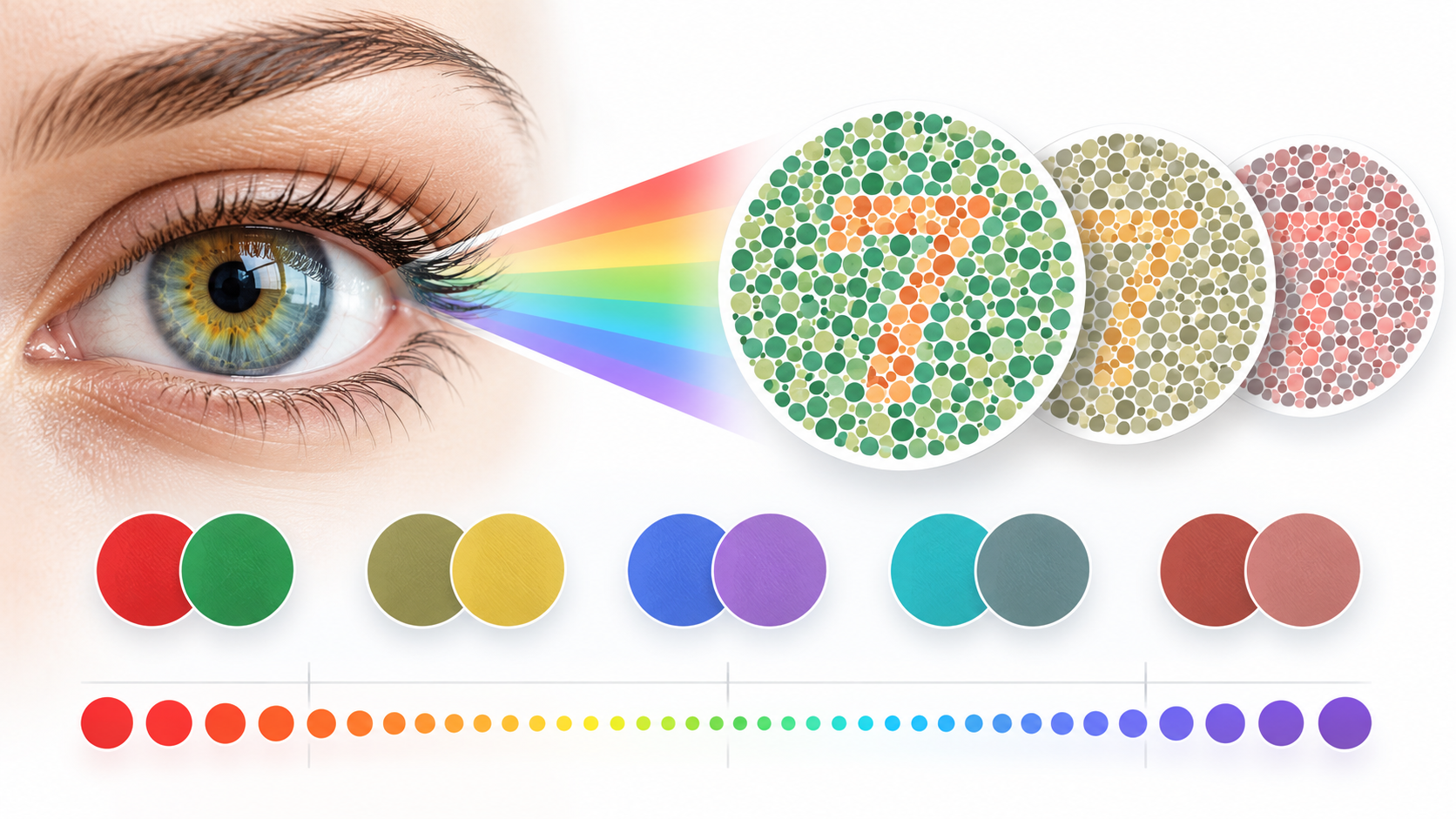
Color blindness — more accurately called color vision deficiency — is a difference in the way a person sees and distinguishes certain colors. It does not usually mean seeing the world in black and white. Most people with color blindness can see many colors normally, but certain shades may look more similar to each other than they do to someone with typical color vision.
Red-green color vision deficiency is by far the most common type, while blue-yellow color vision differences are much less common. Complete color blindness is rare.
If you are wondering whether you may have difficulty distinguishing certain colors, you can try our free color blind test. It takes only a few minutes and does not require signup. The test is intended as an informational screening and is not a medical diagnosis.
What Does Color Blindness Mean?
Color blindness happens when the eyes and brain process color differently from typical color vision. Certain colors that appear clearly different to one person may appear very similar to someone with a color vision deficiency.
Depending on the type of color vision difference, a person may have difficulty distinguishing colors such as:
- Red and green
- Green and brown
- Red and brown
- Orange and green
- Blue and purple
- Blue and green
- Yellow and light green
- Yellow and pink
This is why the phrase color blind can be misleading. Most people with color blindness are not unable to see color. Instead, some colors overlap perceptually and become harder to separate.
How Does Color Vision Work?
Color vision begins in the retina, the light-sensitive tissue at the back of the eye. The retina contains specialized photoreceptor cells called rods and cones. Rods help with low-light vision, while cone cells are responsible for much of our color perception and fine visual detail.
The Three Types of Cone Cells
Humans normally have three types of cone cells. Scientists classify them according to the wavelengths of light they respond to most strongly:
- L cones — most sensitive to longer wavelengths
- M cones — most sensitive to medium wavelengths
- S cones — most sensitive to shorter wavelengths
These are sometimes simplified as red-, green- and blue-sensitive cones, although each cone responds to a broad range of wavelengths rather than to only one color.
The brain compares signals from all three cone systems. Those combined signals allow people with typical color vision to distinguish a very large range of colors and shades.
What Happens When Cone Signals Are Different?
A color vision deficiency can occur when one cone system is missing, functions differently or responds to light differently from typical vision.
As a result, colors that normally produce clearly different signals may create signals that are more alike.
This means two shades that appear obviously different to one person may appear nearly identical to someone with a color vision deficiency.
What Are the Different Types of Color Blindness?
Color blindness is not one single condition. Different types affect different parts of the color spectrum, which is why one person may struggle mainly with reds and greens while another may have difficulty distinguishing blues and yellows.
Red-Green Color Blindness
Red-green color blindness is the most common category of inherited color vision deficiency.
It includes two major groups: protan and deutan color vision differences.
Protan differences involve the long-wavelength-sensitive cone system. Someone with a protan-type difference may have trouble distinguishing reds, greens and browns, and some reds may appear darker than expected.
Common terms include:
- Protanomaly — altered sensitivity of the L-cone system
- Protanopia — absence of normal L-cone function
Deutan differences involve the medium-wavelength-sensitive cone system. Colors such as red, green, orange and brown may be harder to distinguish.
Common terms include:
- Deuteranomaly — altered M-cone sensitivity
- Deuteranopia — absence of normal M-cone function
You can learn more in our guide explaining what deuteranopia is and how it affects color perception.
Blue-Yellow and Complete Color Blindness
Blue-yellow color vision deficiencies, sometimes called tritan color vision differences, are much rarer than red-green deficiencies.
People with a tritan-type deficiency may have difficulty distinguishing colors such as:
- Blue and green
- Yellow and pink
- Purple and red
Unlike common inherited red-green color blindness, inherited tritan deficiencies affect males and females at similar rates.
Complete or nearly complete absence of color vision is much rarer.
One example is achromatopsia, a rare inherited retinal condition that can cause severely reduced color perception along with other symptoms such as light sensitivity and reduced visual acuity.
How Common Is Color Blindness?
Red-green color vision deficiency is relatively common, particularly among males.
Among people of Northern European ancestry, red-green color vision deficiency affects approximately 1 in 12 males and around 1 in 200 females.
The exact prevalence differs among populations and ancestry groups.
Blue-yellow color vision deficiencies are considerably less common than red-green deficiencies, while conditions involving very limited or absent color perception are rare.
Why Is Color Blindness More Common in Males?
The most common inherited red-green color vision deficiencies are associated with genes located on the X chromosome.
People with only one X chromosome are more likely to show an X-linked color vision deficiency when the relevant gene is altered because there is no second X chromosome carrying another copy of the gene.
This is why inherited red-green color blindness occurs much more frequently in males than females.
What Causes Color Blindness?
Most people with color blindness inherit the condition and have had it since birth. However, color vision can also change later in life.
Inherited Color Vision Deficiency
Inherited color blindness results from genetic differences affecting cone-cell photopigments.
The most common inherited red-green deficiencies involve genes connected to the long- and medium-wavelength cone systems.
Inherited color vision differences are generally present throughout life and usually do not suddenly worsen.
Acquired Changes in Color Vision
Not every color vision problem is inherited. Changes in color perception can sometimes develop because of conditions affecting the retina, optic nerve or areas of the brain involved in vision.
Possible causes can include certain eye diseases, injuries, neurological conditions, some medications and age-related changes.
A new or sudden change in color vision should be evaluated by an eye-care professional, especially if it affects one eye more than the other or occurs alongside additional changes in vision.
What Does the World Look Like to Someone Who Is Color Blind?
There is no single view that represents what every color-blind person sees. Different forms of color vision deficiency affect color perception in different ways.
A common misconception is that color blindness makes everything look gray. For most people with color vision deficiency, this is not the case.
Instead, certain colors may look more alike.
For example, someone with a red-green color vision difference may easily recognize bright blue but have difficulty deciding whether a darker object is green, brown or red.
If you want to explore these differences visually, try our Color Blindness Simulator. You can upload a photo, graphic or chart and compare approximate protan, deutan, tritan and achromatopsia views.
Simulators are educational tools and approximations. They cannot reproduce exactly how every individual with color vision deficiency sees the world.
What Are Common Signs of Color Blindness?
Many people with mild color vision deficiency do not realize they have it. Because they have always seen colors in the same way, they may assume everyone else sees them similarly.
Possible signs include:
- Frequently confusing particular colors
- Difficulty identifying shades of red, green or brown
- Confusing blue and purple
- Difficulty reading color-coded charts or maps
- Needing labels to distinguish similar-colored clothing
- Difficulty interpreting status or warning lights based only on color
- Relying on position or labels rather than color
How Can You Tell If a Child Is Color Blind?
Color vision differences can be particularly difficult to recognize in children because younger children may not have the vocabulary to explain that two colors look similar.
Parents and teachers may instead notice repeated behaviors such as:
- Confusing the same crayon colors repeatedly
- Making unusual but consistent color choices in drawings
- Having difficulty with color-coded worksheets
- Struggling with maps, charts or educational activities that rely on color
If you are concerned about a child, read our guide to signs your child may be color blind.
You can also use our picture-based color blind test for kids, designed to make screening easier for younger users. It is an educational screening tool rather than a diagnosis.
How Is Color Blindness Tested?
Color vision can be evaluated using several different methods.
One of the best-known methods uses patterns of colored dots containing numbers, lines or shapes. Different color vision patterns may cause people to perceive different figures within the same image.
The Ishihara test is one well-known example used primarily to identify red-green color vision deficiencies.
Another testing approach asks a person to arrange colored samples in order based on hue. Patterns of errors can help an eye-care professional identify specific types of color discrimination difficulty.
Online color vision tests offer a convenient first screening, but results can be influenced by:
- Screen brightness
- Monitor or phone calibration
- Night mode
- Blue-light filters
- Ambient lighting
- Screen quality
You can try our free online color blind test to screen for common patterns of color vision deficiency.
You can also read how ColorBlindChecker's screenings work and what their limitations are.
Can Color Blindness Be Cured?
There is currently no routine cure for the most common inherited forms of red-green color vision deficiency.
Most people learn to adapt by using context, labels, position, brightness, patterns and other visual cues rather than relying entirely on color.
Technology can also help. Color-identification tools, accessibility settings and visual design features can make color-dependent information easier to understand.
Some tinted lenses may increase contrast between certain colors for some users, but they do not restore typical cone function or cure inherited color blindness.
Does Color Blindness Affect Everyday Life?
For many people, color blindness causes only minor day-to-day inconvenience. For others, color-dependent tasks can be frustrating.
Common examples include:
- Reading maps that rely on color alone
- Interpreting graphs or dashboards
- Matching clothing
- Determining whether certain foods are ripe
- Identifying warning or status lights
- Reading school materials that use color coding
- Using websites with poor color contrast
Good accessibility design can eliminate many of these problems. Important information should not be communicated by color alone. Labels, icons, shapes, patterns and sufficient contrast can make content easier to understand for everyone.
Can You Test Your Color Vision Online?
Yes. An online screening can help identify patterns suggesting that you may distinguish colors differently from most users.
For better results:
- Use a reasonably bright screen
- Turn off Night Shift or night mode
- Disable strong blue-light filtering
- Avoid screen glare
- Take the test in normal room lighting
Our free ColorBlindChecker color vision test takes only a few minutes, requires no signup and provides immediate results.
If the results suggest a possible color vision difference — particularly if you have noticed a recent change in your vision — consider discussing the results with an optometrist or ophthalmologist.
Frequently Asked Questions About Color Blindness
Do color-blind people see everything in black and white?
No. Most people with color vision deficiency see many colors. They mainly have difficulty distinguishing certain colors or shades.
What is the most common type of color blindness?
Red-green color vision deficiency is the most common category, with deutan-type differences particularly common.
Is color blindness more common in men?
Yes. Common inherited red-green color vision deficiencies are X-linked, which is why they occur much more frequently in males.
Can color blindness develop later in life?
Yes. Although most cases are inherited, acquired changes in color vision can occur because of eye disease, neurological conditions, injuries, certain medications or age-related changes.
Can children be color blind?
Yes. Inherited color vision deficiency is present from birth, although parents or teachers may not notice it until the child begins working with colors in school.
Is an online color blind test accurate?
Online tests can be useful screening tools, but screen quality, calibration, brightness, lighting and device settings can affect results. Professional eye testing is required for clinical evaluation.
Take a Free Color Blind Test
If you have ever wondered whether you see colors differently from other people, a simple screening can be a useful first step.
Take the free ColorBlindChecker color vision test →
The screening takes only a few minutes, requires no signup and provides instant results.
ColorBlindChecker provides educational screenings and accessibility tools. Online results are not a medical diagnosis and do not replace an examination by a qualified eye-care professional.
Sources and Further Reading
- National Eye Institute — Color Blindness
- MedlinePlus Genetics — Color Vision Deficiency
- MedlinePlus Genetics — Achromatopsia